
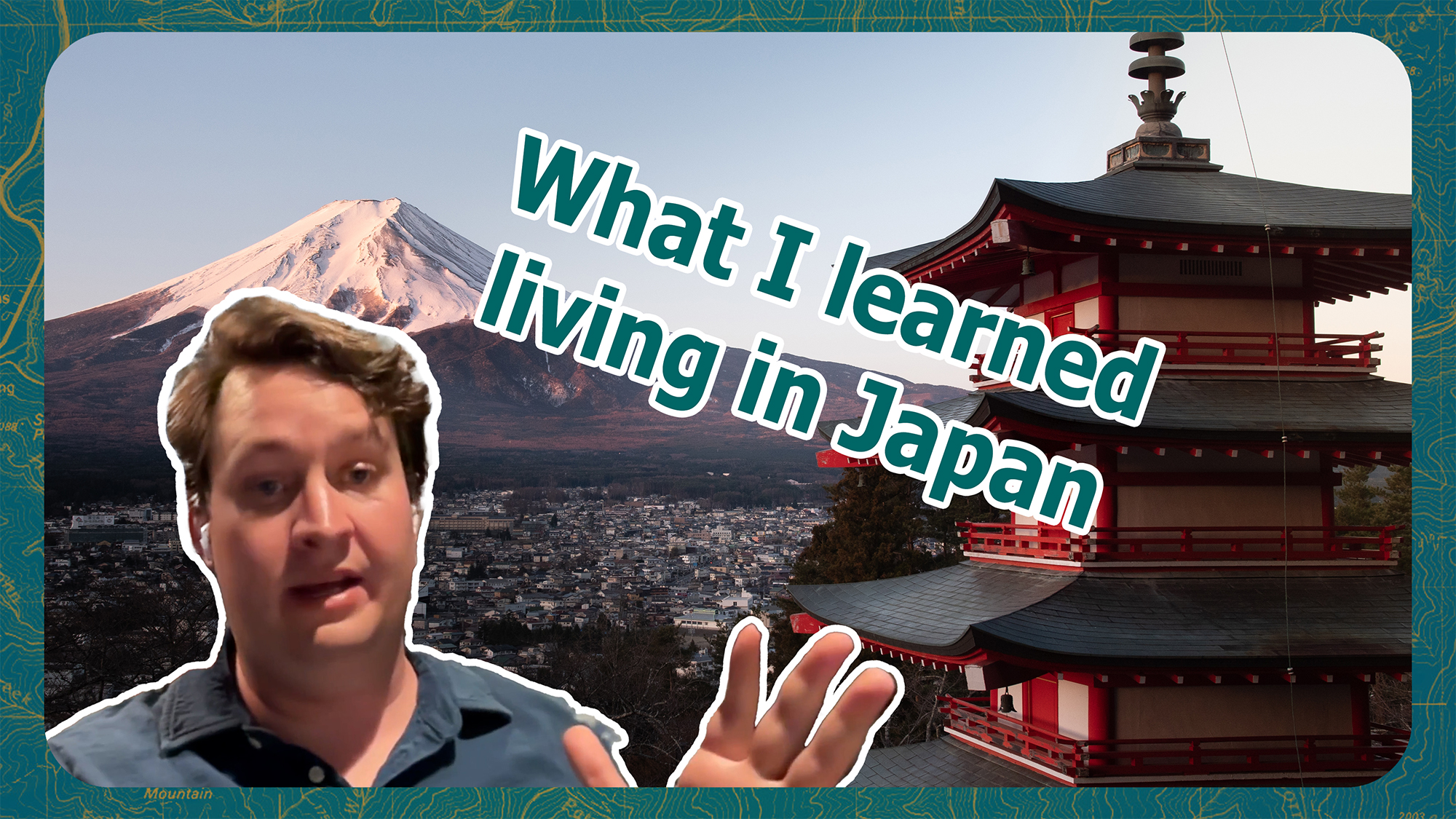
From the Near and Far podcast with host Zackery Ellis
Zackery: Welcome to the Near and Far podcast. I’m Zackery Ellis, and this show is all about embracing curiosity, leaping beyond your comfort zone, and learning from adventurers like yourself who have traveled near and far. We’re joined today by our guest, Michael Zislis. Michael founded JPN Guides, where he uses his experience having lived in Japan to create personalized guidebooks so travelers can confidently wander off the beaten path. Welcome to the show, Michael.
Michael: How’s it going? How’s everything going?
Zackery: It’s going pretty well. Today is a good day.
Zackery: Michael, you spent several years living in Japan, and you’ve also gone back many, many times. But what inspired your first trip to the land of the rising sun?
Michael: You know, to kind of go off what your guys’ podcast is about, you know, it was kind of taking that leap of faith when I was kind of in my high school years. I was curious about trying sushi. I wanted to kind of go beyond the normal California roll, things like that. And I was lucky enough, my uncle’s a big foodie, and we just kind of started off on this path where he took me to one place. I did my best. And then we just kind of kept building throughout that, you know, that kind of course of my high school years. And then right around my senior year, he gave me this opportunity. He said, hey, I’m planning to go to Japan. I want to go to all these different restaurants. Some of them are sushi places. And if you can help me plan the trip and get me into these restaurants, I’ll take you with me. Yeah, I was able to plan the trip. And it was just kind of a life changing experience being able to go to Japan for the first time, being able to sit down at some of these elite sushi counters and places like that. And I guess it just left an impression on me where I just wanted to go back and explore more.
Zackery: Yeah, that’s quite the first trip. Was that your first time overseas?
Michael: No, it wasn’t. I’d been to England once and you know, in Europe, but it was my first time in Asia. And I do want to say to all the people out there, man, going to Europe versus visiting Asia is quite different. And it’s full of just amazing, amazing discoveries. You can really just kind of find your place in the world when you’re in such a different environment. You know, in Europe, people are like us. They look like us. They kind of have similar views on life. But when you go to a place as far away as Asia, you really get to see how other people are living, how other people view the world. And it really impacted me.
Zackery: What was the biggest shock to you while you were there the first time?
Michael: I remember the biggest shock, honestly, like… just looking at a street and noticing how clean it was. Like we were, you know, walking towards our hotel and just looking around, it looked like we were in a city that had just been built by American standards, like a suburb that had just been built and you got a tour of it. But I was in the middle of downtown Tokyo and it was the cleanliness, how nice the people were there. And then just… interacting with the culture and uh just kind of like seeing how it moved and how it breathed and lived and uh it just really grabbed me and it was just it kind of prompted me to be like wow this city especially like tokyo was the first kind of like rendezvous with japan but it made me just be like i left the city going i barely scratched the surface i might have visited one sixteenth of the entire city you know
Zackery: Yeah, I don’t think people realize just how huge Tokyo is. You think about how New York City is the cultural impact that New York has on the United States, but am I correct in my assumption that Tokyo is even more so?
Michael: In a way, I would say one thing I read recently, very interesting, the population of the greater Tokyo area, which includes the suburbs and where people are commuting, has a population roughly about the same size as the state of California.
Zackery: Whoa.
Michael: So it’s about 33 million people. In one metro area. In one metro area. So it goes vertical and it goes out. And like I said, when you go there for the first time and when I talk to people about making guides and stuff, I really tell them. it’s really easy to get locked into a block just because you feel safe and there’s so much to see you know like all of a sudden like one of my favorite ramen shops i suggest to people is the ramen shop down the street from the first hotel that i stayed at when i went to tokyo and we just happened to wander in we you know we needed a bite to eat after the plane and It’s an amazing spot.
Michael: I have a friend that’s a really big ramen reviewer. He’s the only American person that is a professional ramen critic in Japan. They have magazines for grading ramen. And he was able to go there, and he gave it the stamp. So I’m pretty proud.
Zackery: Congrats on finding that place. Yeah. What a lucky turn of events getting to go on that trip in high school. Your first night there, you find this amazing ramen place. What was the best sushi roll you had on that trip?
Michael: You know, my favorite sushi place in Tokyo is a place that everybody can go to. Asterisk, like with a caveat. It’s a place in the fish market. Recently, they’ve moved from Tsukiji to a newer, nicer market. It’s called Toyosu. And there’s a famous sushi spot in the market called Sushi Dai, D-A-I, which is the Chinese symbol for big. But it is walk-ins only. And they’re open from around 5:30 in the morning until 2 p.m. It’s got weird hours, but the whole thing is the fish market is open very early in the morning. So even if you go there at four in the morning, you might find a 30 minute to one hour wait. And it’s cash only. It’s about right now, about $45 a person. And I’ll tell you, it’s the best sushi I’ve ever had for the price. And there they do kind of like an omakase. So they serve you the traditional fish of the season. But I’ll just never forget, like, when you get to have, like, a piece of, like, Otoro or they make, like, a maki. Like, you’ve never seen, like, a roll that features such an expensive fish, like a Toro maki or something like that. When you get to try it as a sushi roll and you’re there and it’s the morning, it’s quite a magical experience. I always tell people, too, have you seen at the end of a sushi dinner, usually they’ll serve you a piece of, like, an egg? Looks like an omelet.
Zackery: I’m not sure I’ve seen that, actually.
Michael: So it’s a very traditional piece. A lot of people kind of like to skip out on it and I understand, but there they serve it hot. Usually it’s like being cooled down and they serve it hot. And as an American you’re there, it’s five in the morning. And then someone serves you a very delicious thing of scrambled eggs. And you feel like this was the ultimate end cap to the perfect breakfast. And yeah, I recommend it to everybody that goes to Japan on my tours, but I tell them, you know, You got to be game to wait. Nowadays, they have a list where you can write your name down and you can come back. But yeah, that is a place to me that is, it’s the zenith of quality and price and no pretentiousness. You don’t have to, you know, start trying to plan this trip about six months out. It’s a place you can kind of stumble into and it’s a life-changing one.
Zackery: That is such a fantastic insider tip. I would have made the mistake of not going and seeking out sushi at five in the morning.
Michael: You would think so. But actually sushi is a light, you know, it’s a light food and they give you miso soup with it. And you can have hot tea. You can have water. And yeah, at first I was kind of taken aback by it. But I’ve waited in that line many times. And it’s actually really fun. There are tourists from around the world that go. And I find myself having conversations with people from. Europe or other parts of Asia, Australia, Americas, and they’re all there to try that sushi.
Zackery: Yeah, that’s a cultural moment in and of itself, isn’t it?
Michael: Yeah, it’s really cool. You’re just sitting around and you see people and you’ll be like… hmm like where are you from and they’ll be like oh we’re from vancouver and you’re like oh my goodness like that’s so cool and you guys start talking and they’ll tell you about what they’ve been doing on their trip and you tell them a little bit about what you’ve been doing on your trip and you can pick up information actually one time uh was in line next to a guy that was like on a mission to try all of the best like 15 or there’s like 100 best bowls of ramen in tokyo they do every year But he was out there trying to eat like the top 10. And he let me know about this list. There’s this, it’s kind of like Yelp for Japan. It’s called Tabe, Tēbururogu or like Table Log. And it’s Japan’s Yelp. And every year for all these different types of food, they’ll do like a top 100 in Tokyo, like in all the cities. And then they do like a top in the country. And Japanese people, I’d say like. We’ll get into it more, but one of the biggest things about traveling to Japan is that Japanese people love everything that we’re going to see as much as we do. So when you go there, expect to see other Japanese people there. It’s not like how in America certain things kind of become passé to a local. Like there, it’s like, oh, my gosh, like we’re going to take the weekend and go to Tokyo and like we’re going to do all these things. And yeah, Japanese people are very passionate about, you know, ranking food, traveling to eat food, traveling to certain experiences. And yeah, it’s really cool.
Zackery: You’re making me excited to head out to head to the Far East someday, though you lived there for how many years, two or three years?
Michael: I lived there for about two and a half years. Yeah.
Zackery: And you were in a place quite different from Tokyo, if I recall.
Michael: Yeah, I was in a place. It’s a town called Niigata. And it’s about three hours northeast of Tokyo on the Shinkansen or the bullet train. And you just go north, you just go straight up. And it’s a town on the coast looking at the East China Sea. And you can kind of see little visages of Korea from there. But it’s a totally different place. It’s very, very countryside. 60% of Japan’s rice crop is grown there. And because of that, some of Japan’s sake breweries are there. I would talk to people in Tokyo. I would be in town. While I was living there, I’d commute to Tokyo for business. I’d be at a restaurant, and people would be like, where do you live? I’d say, oh, I live in Niigata. Mind you, you and I, Tokyo is the zenith of food. You would see these people go, oh my gosh, you live there? That’s where the best food is, the best water’s there, the best sake. I kind of now equate it to living in a place like Sonoma. In California, you know, just a place where if you told someone, yeah, I live in Napa Valley, they’d be like, well, it’s the most beautiful place on the planet. You know, it’s got so much good stuff.
Zackery: Well, let’s take a quick moment and we’ll come back. We’ll hear way more about this and way more about sake and traveling off the beaten path.
[Brief interlude]
Zackery: Best sake surrounded by rice fields, the East China Sea. What other off-the-beaten-path gems would people find as they’re venturing around Japan?
Michael: You know, for me, when it comes to getting off the beaten path, right now, Japan’s kind of in a crux. There’s a very, very convenient train line known as the Tokaido Shinkansen. And the Tokaido Shinkansen conveniently stops at the cities of Tokyo, Kyoto, and Osaka. These are the three biggest cities in Japan, and they each offer their own little unique thing. Like Osaka is like a little mix of like New Orleans and like Boston. Kyoto is very, very prim and proper and full of temples and green tea. And then Tokyo is like this like super high-tech. place and a big thing that we try to do when i’m talking to clients to talk to them about japan is um getting them to get off that beaten path and maybe take one of these shinkansen and go on another line because all of them lead to tokyo all roads lead to rome and uh i would kind of say My biggest place that I recommend people to go to is the city of Sapporo. You can get there if you want to. It’s about a six hour Shinkansen ride all up the coast of Japan. And it’s very beautiful, apparently. And if you’re wanting to really see the countryside, it’s really nice. And then you go through like this very new tunnel that goes under the ocean. And then you’re on the island of Hokkaido. And the whole thing about Hokkaido that’s so cool to me is that The weather there is either extremely cold and snowy and beautiful. They have an ice festival. It’s really good for skiing. Most people know Hokkaido from this very famous ski area called Niseko, which is like Japan’s Aspen, if you will.
Zackery: Yeah, I’ve actually heard of that. And I’ve heard the snow there is unparalleled.
Michael: Yeah, it’s very, very nice. And it’s a very beautiful town too. And like I said, it’s very akin to Aspen. Like I would say Niseko is a bit too rich for me personally. But then like all around there, you can go into the city of Sapporo. And the big thing I tell people is, you know how on the east coast of the United States, all of the cities like Boston, not New York, but like Boston, Philadelphia, were built in a time when there was horse and buggy and all the streets go winding. very hard to get around. The city of Sapporo was built in the 1800s. So it’s got a layout really similar to the city of Manhattan where everything is gridded. They have a central park. There’s an underground city because it gets so cold. It’s kind of like Japan’s seafood basket. A lot of Japan’s really great premium seafood is coming from around the Arctic. Things like sea urchin, crab, salmon, all those types of fish are coming through Hokkaido. When a lot of Japanese people think about going there, they think to go eat seafood. And I just think it’s a really good place to go and you can experience Japan. It’s not as expensive as Tokyo. It’s easier to get around than Tokyo is. And it’s just got so many great things. like miso ramen for instance was invented there and it’s uh you know everybody loves i feel like miso and miso ramen and you can go there and you can try like the world’s first shop that ever served miso ramen in the 1960s it’s quite amazing
Zackery: Wow, yeah that’s amazing. Is Sapporo also the home of Japan’s first beer brewery?
Michael: Yes, it is. I can’t even believe I left that out. You can also go to the Sapporo Brewery, which is very cool. It was built in, I want to say, the late 1800s. And it was first kind of like a national corporation or sponsored by the government, which is why their logo is a red star. It was almost like, not communist, but it was the state-run brewery of Japan. Over time, they privatized. And now you can go there and they have Sapporo and Hokkaido in general is really famous for this kind of cook-it-yourself barbecue that they call Genghis Khan, which is like Genghis Khan. Yep. And instead of eating beef or pork or anything, they eat like lamb. Oh. And it’s really good. Like they serve you all these vegetables and they bring you all this meat and you sit at this table and they’ve converted like the old beer hall into this big Genghis Khan restaurant. And you can go and like you can order a beer and then they bring out all this like meat and vegetables and stuff. And the grill is shaped like a kind of pyramid, like a conical pyramid. And you can build it up with the vegetables on the top and then going down. Nothing better in the summertime than being in Sapporo with a tall glass of Sapporo and having Genghis Khan. It’s nice.
Zackery: That is not what I was expecting to learn today.
Michael: Yeah, I actually almost even forgot about it. But it is true, you cannot go to Sapporo without trying that food. I mean, if you love things like Korean barbecue, things like that, where like you get to cook the food yourself. It’s right down your alley.
Zackery: I could talk about food all day, and I’m sure there are plenty of people who would love to hear it. But as somebody who’s from the West, are there any etiquette rules around like visiting a Shinto temple or something that I might not be aware of?
Michael: You know, I would just say it’s kind of the little obvious things, which may not be obvious when you’re, you know, in a rush or, you know what I mean, kind of living life. Things kind of like trying to be quiet, not really using your cell phone, you know, and if you are going to take a picture or two, being really kind of like kind about it, maybe not getting people, you know, bystanders in the picture. But I would say the biggest thing is. When you go to a temple, try to walk around in the same places that everybody else is walking in, because you might find yourself walking towards an area where maybe people aren’t allowed to be. You know, you see when people go to a temple, it’s pretty… pretty cut and dry they go there there’s like a little stand that you can go to before where people get like a stamp a lot of Japanese people have a thing where they want to visit every temple in Japan and they get a stamp at each temple so you can get that you can get these little charms and souvenirs but then kind of what you’re supposed to do is follow everybody else in line if there is a line and you can go up and there will be like a big kind of like either like a Buddhist or Shinto kind of shrine that you can’t even walk into. Like only the priests can walk in and you’re kind of usually separated by a net or like there’s a big coffer, like a big chest. And you’re just supposed to walk up to it. You throw whatever change that you might have in there. You ring a little bell and then maybe I don’t have it right, but you’re supposed to kind of clap twice, bell, then look up. clap again, bow, and then head out. Kind of one of the things I love about Japanese spirituality. It’s more just about taking a moment to, you know, notice the spirituality of things. We don’t need a 30-minute service.
Zackery: Yeah, and so many of these places are in such beautiful surroundings that I imagine it’s easy to appreciate the beauty and the spiritual nature of wherever you are.
Michael: Yeah, and that’s a big reason why I try to get people off the beaten path. Like, you know, where I’m right now, Sensoji Temple, it’s in the middle of Tokyo. It’s right in the middle of the hustle and bustle. And it does feel quiet, but if you go there on a busy day, it feels like a busy market. And when you get to go to some of these temples, if you’re in a small town or if you get off that beaten path and you’re visiting a smaller area and you get to go to a temple and it’s… up a you know a thing of you know cobblestone stairs and you get to the top and it’s super quiet and nobody’s there it may it may look like nobody’s been there in a few days you know you’re like are people updating this place what’s going on but everything’s there there’s like fresh papers and all that and you just feel the silence and you can look around and you can breathe the air and um in Niigata the big shrine there it’s called or near town it’s called Yahiko Shrine. And they say that the god of that shrine actually lives in the mountain behind the shrine. And it’s like this really cool moment where you can kind of be like, wow, like the god per se is not really in this temple or anything. It’s all around us. And this shrine is kind of like our place to be spiritual. To me, Shintoism is a lot about mindfulness. It’s a lot about realizing that we’re all connected. The water, the wind, us as people, animals, we’re all coexisting. And when you can take that moment in a quiet place and do that bow and feel the wind and hear the silence and the birds, it’s truly a profound experience.
Zackery: Yeah, it sounds like it. And how, while you were living there, I… I’m just trying to wrap my head around what it’s like actually residing in a place so different than where you grew up. I’ve only ever lived in the United States, and sometimes there’s enough of a, like, society is different enough that it can be challenging just being a tourist. But you were dedicated to being there and immersing yourself.
Michael: It is very different. I was actually just talking about it with somebody today. Even things like throwing out the garbage are very different in Japan. You have to sort it out, even down to you can’t throw away broken glass with other glass. There’s a special day for the trash where you can throw out broken glass or porcelain. Little things in your life change. As a Westerner, all the cheese is in really small containers. You can’t buy a big bag of cheese to save your life.
Zackery: I would struggle with that.
Michael: I struggled all the time. Little things like that. But then, you know, for me, it was, you know, it was like give and take. There were a lot of parts that I found really beautiful about living there, like being able to go to these beautiful places all the time. All the local food is amazing. People are very nice in general. But I’d say the little things are like Japanese people aren’t really big on small talk like we are. Like if I saw you on the train or something and you were wearing a cool shirt, it’s not really appropriate for me to be like, hey, cool shirt. You know what I mean? Like they would kind of see that as an intrusion into their morning commute, which to a lot of people is a sacred time. This Is also the case in small towns. It’s also the case in small towns. Whenever you’re on public transit or like you’re out in public, people are living their lives. And the Japanese outlook on it is. you’re we’re not trying to intrude you know what i mean i’m not trying to um interrupt your day it’s nothing like i don’t want to talk to you or i’m not interested it’s more like they don’t want to offend you by possibly like popping in and like asking you a question that could possibly offend you or like make you sad or something like that like i heard someone say like imagine if like that shirt that you had was something that like your you know family member gave you that just passed away and all of a sudden like you started getting really sad like thinking about them like they would hate for that to happen but for somebody as social as me it was really tough sometimes like i’d want to talk to people or like make a little bit of small talk at the counter while i’m checking out and uh things like that made me realize like wow this is a different culture like definitely not everywhere’s the same and it was a like a lesson because i was at first like kind of offended i was like what people don’t want to talk to me this is lame but as i as i learned the reasons why I kind of understood like people are just doing their thing and they don’t want to intrude on you doing your thing. And it’s kind of like this, we’re keeping everything really peaceful and copacetic.
Zackery: That is so considerate, but also it would not be intuitive to tourists from like North America. Is the best thing just to observe what people are doing around you and try to blend in as much as you can then?
Michael: Kind of. In Japan, you know how we say here in America, the sticky wheel gets the grease or something like that? Yeah. The squeaky wheel gets the grease. If you’re speaking out about something, you’re going to get help. In Japan, they have a very different phrase. It says, “the nail that sticks up gets hammered down.” So in Japan, they really want people, you know, moving with the mass, going with the kind of groupthink, and everybody’s in this together. So we’re all doing our best to make sure that this society is peaceful and it moves along. in a nice way and that’s why like very recently with this big tourism boom you’re seeing a lot of tourists get in trouble on the subway and they’re not understanding that strict etiquette of the subway like can’t be talking on the phone can’t really be playing loud music you can’t sit with your legs open or you know what i mean it’s this very thing where they’re all following those rules every single day before you even got here. So the moment you start doing that, it’s less like they’re mad at you. They’re just mad that you’re not doing as the Romans do, if you will. So in Japan, if you’re ever at a certain time unsure of what to do or unsure of how to act, I would just take a look around and you’ll probably notice everybody being very quiet and keeping to themselves. yeah sometimes it makes for a less fun train ride home you know after a beer or something like that but uh i think it’s better in the long run because we all want to keep visiting japan we all want to keep having fun there and uh yeah like i said it’s a very um homogeneous population and culture noticing what they do and kind of doing it as they do it really gives you brownie points in their book. They don’t like the individual as much as we do in America. We love to be individuals. We love to speak out and speak our mind, things like that.
Zackery: Maybe to a fault.
Michael: Maybe to a fault. Japan is the place where that isn’t as revered, and you’re not like, oh, this is a cool guy, you know what I mean? It’s more like… This guy’s kind of like, he’s like noise, like static noise in this otherwise very peaceful situation. Doesn’t matter what you’re saying or if it’s a good point.
Zackery: You’ve given so much good advice so far. I’m excited for this next part. When we come back, we’re going to, now that we know what to do and what not to do and some of the places to go, we’re going to go through the process that JPN Guides uses to help curate and… and put together a custom guidebook for people who work with them.
[Brief interlude]
Zackery: Michael has so generously offered to help me plan my future trip to Japan. I have no idea when this will be, but I’ve scoured through the JPN Guide’s website. It looks like there’s some really neat cultural experiences, knife making, and I am excited to find out what kind of guide Michael would put together for me.
Michael: Nice. Well, just to start off, I kind of start off with this. Usually people have a time frame of when they want to go. But since you are, we’re just kind of dreaming this up. My one question would be, is there a certain season that you would really want to see Japan in? Is the cherry blossoms a big thing? Or are you a winter sports enthusiast? That type of kind of desire. Are there any kind of seasons that might be best for you?
Zackery: That’s a good question. So I do love skiing. It sounds like I, Hokkaido might be out of my price range though i could hopefully swing and make it work for a day cherry blossoms are beautiful i definitely don’t want to be there during the heat of summer i hear it’s not the most pleasant place and i don’t do well in humidity i get frizzy um likewise um
Michael: i would then recommend i feel like for you like early spring is the best time to go to japan um i either like to personally i like autumn and i like spring but if you were to go there in like early march or even like the towards the end of march it’s still ski season and there’s tons of mountains japan is a very it’s a mountainous island you know the island of honshu and um from tokyo there are mountains that are about maybe two and a half hours away like the ski resort in hakuba which is um kind of in nagano next to nigata where i was and then nigata has tons of skiing and stuff and don’t worry it won’t break the bank it’s full of places where you can get a lift ticket for like 20 bucks and wow you can go skiing for the day and my favorite thing i went snowboarding there once was you can go to the hot spring after skiing so after you go and like just destroy your body and get sore falling a bunch of times or you know whenever i snowboard i’m like wow like my hips and like My rear end hurts from, you know, just sitting down or, you know, falling. Being able to go to a hot spring after skiing is quite the experience. We don’t have that here.
Zackery: Are the hot springs there all developed or do they have primitive springs where you can hike in?
Michael: They do have primitive springs where you can hike in and there are tons of trails and things. I wouldn’t really suggest that. I feel like that’s for something like if you were to have a personal tour guide or a friend that might know. But there are so many like onsens that you can either, go there and stay the night and it’s like a like a traditional hotel experience or you can just stop in and i find it very um endearing it’s like almost like a family community center mixed with all of these baths and like you can just kind of see the pulse of the town there’s kids there there’s old people there’s vending machines like there’s this whole thing where you’re supposed to get like a cold glass of milk after the hot spring and like they make this coffee flavored milk and I’ve never had it before in my life, but man, after you go to the hot spring, get yourself a coffee-flavored milk. Some of these places will have a restaurant inside, and restaurants are really good. It’s just a great way to spend the day after a day on the slopes instead of just going back to your room and plopping on the bed or the couch.
Zackery: That sounds marvelous. So I assume on day one, I’ll fly into Tokyo and get that ramen you recommended earlier. Day two, head into the mountains, ski, and hit up a hot spring with some coffee-flavored milk.
Michael: Definitely. And so that’s a big thing, too, when I plan these trips. You know, our big thing is getting people off the beaten path. But because of international flights and all that, you’re destined to either fly into Osaka or Tokyo. And I would be extremely remiss, and I would not be doing my job if I didn’t tell you, spend a couple days in Tokyo. Get the feel. It’s going to be a little bit cooler and less snowy than when you start to go up to the mountains. And depending on the kind of your trip and, you know, where you want to go, I feel like you could go to Tokyo and then find a resort that kind of best fits where you want to travel. You could go to Nagano, Niigata, Yamagata. You can kind of take either the Joetsu Shinkansen or the Tohoku. From there, you’re actually kind of like going up through there and you’ll be able to kind of see like a little bit more winter if you want. But then if you wanted to see the spring, you could go up and ski and then just kind of turn south and maybe head towards a place like Nagasaki or Hiroshima or Kyoto. And as you start to go more south, you’ll start to see spring really like awakening. And a big thing that I’ll tell to all the listeners out there, Japan makes a cherry blossom map every year.
Zackery: Oh, cool.
Michael: It’s very serious. The Japan Meteorological Society puts it out every year. And because Japan is so across different latitudes, the cherry blossoms in Nagasaki will actually start to bloom in early to mid-March, whereas like in Tokyo, they start to bloom around April. And then if you’re like, man, I could make it to cherry blossom season. Don’t worry. If you go up to Sapporo, they don’t start blooming until early May.
Zackery: Oh, wow. So you’ve got a window.
Michael: you really got a window and depending on how like like i said like you could almost do both with like a trip like you’re planning where you could almost spend a little time in a place like nagano where you’re very up elevation wise you’re in the mountains so there’s going to be skiing there’s going to be snow and snowpack and then you can get on the hokuriku shinkansen take that all the way down to a place like kyoto get that real zen vibe that’s a city too that you know people are going there in droves but You’ve got to see it. It’s the traditional capital of Japan. And then from there, you could just keep going south. And as you keep going south, the weather keeps getting better. Or if you want more snow, go north. The weather’s not good yet.
Zackery: Will this guide have any language tips in it? Because I’m realizing now that I might have some trouble getting around.
Michael: So the first part of the guide, and it’s kind of like a thing that I do in every guide, there will be kind of like… quick phrases to learn. And then I do a big thing on recognizable, they’re called kanji or Chinese symbols. Japan has three different alphabets. And for really official things like writing your name or doctor’s office, police, they will use Chinese characters. It’s very official. And so I kind of write in things like this is what hospital is, this is a police station, this is enter, exit, bathroom, and things like that. Because, you know, I’m not expecting you to learn a bunch of Japanese and phrases. So I’m going to give you a few phrases to learn. My biggest one I tell everybody is sumimasen. And sumimasen means
Zackery: like, excuse me. Did I catch that right? Sumimasen?
Michael: Mm-hmm. Perfect. Sumimasen. Sumimasen. Mm-hmm.
Zackery: Does the accent matter? Does it have to be sumimasen? If I say sumimasen, will it mean something entirely different?
Michael: As a foreigner, they’ll appreciate you trying. There won’t be a loss in translation moment, but it’s like Japanese is broken up into sounds. So you can just remember, Sumimasen. Sumimasen. And it means excuse me, but you’ll use it to ask somebody, you know, for their attention at the train station. Sumimasen. Or you’ll be at a restaurant. In Japan, at restaurants, you can yell sumimasen at the server. It’s very different, but you can be like, sumimasen, and they’ll yell hi, which is yes, and they’ll come to you when they’re done. But then it’s also like if someone bumps into you or you bump into somebody, sumimasen, it’s “excuse me.” So in a very polite culture, knowing excuse me, I think, is one of the most powerful words. If you’re not going to learn any other phrase, Sumimasen. It’s, you know, you’ll be using it all the time.
Zackery: That is good advice. The first word I usually learn is whatever the word for coffee is, followed by the word for bathroom, and thank you is in there, but sumimasen.
Michael: And the nice thing, if you mention coffee, a lot of Japanese words are cognates. They’re borrowed words from Western culture. So coffee is Kōhī. Toilet is toire, they have like a fancy word for saying bathroom but you don’t need to know it but yeah a lot of those words like that like it kind of sounds weird as a westerner you feel like you may be like offending somebody but the more you try to make it sound japanese the more they’ll understand you like if i were to tell you like oh i’m from vancouver like they might not understand you but then if i was like i’m from bonkuba I made it sound very Japanese. They’ll be like, oh, you’re from Vancouver. You know, sometimes they just don’t really understand. Like we like to push words together or two O’s make tool. We like to have our words kind of meld as we spell them. In Japan, it’s block sounds. So the more you can make it into that block sound, like if you’re looking for like a cola or like a soda, you can be like cola or, you know, something like that. And people will be able to direct you or things like that.
Zackery: That’s really good to know because I definitely don’t want to be one of those tourists who just yells things slowly in the hopes that somebody understands. And I’ve also known people who couldn’t understand American accents. So I have a good family friend who’s an elderly Greek woman and she knows fluent English but cannot understand me unless I do my impersonation of an elderly Greek woman.
Michael: Exactly. And like I said, I had that kind of reservation at one point. But then once you start to do it and just sound Japanese, you’ll be able to break that barrier. And that’s what that first part of the guide is all about is kind of showing you some really good phrases like where is the bathroom? Hello. Thank you. You know, they’re very boilerplate phrases that you can learn. And when I write them out, I give you the block way of pronouncing it like. Because Japanese is, it’s all, like, every one of the two phonetic alphabets, it’s, like, a-a-u-a-o. And then everything is kind of, like, a deviation from that. So it’s, like, ka-ke-ku-ke-ko, ma-me-mu-me-mo, pa-pi-pu-pe-po. So there’s only, like, a certain, like, lexicon of sounds that you can make. And once you say, like, when I was, like, Vancouver, like, it gets all weird. it’s blocked out and it’s ready for them to understand
Zackery: what other useful things am i going to find in this guide
Michael: so like as we make your guide we’re just going to kind of dream like you’re going to be taking a trip where you go to tokyo um you’re going to be going up to the mountains and then maybe from the mountains maybe down south to maybe see if you can try your luck get some cherry blossoms in your guide i would actually be working with you and find out like if i can what hotels you’re going to stay at what flights maybe like if you have like a set of days and You’re going to have an itinerary that’s already in there. You’re going to have a packing list based on the season. And then it’s going to have like a little brief guide about every city that you go to. And when I do like the Tokyo part of it, I really try to zoom in on where you’re staying exactly because Tokyo is so big. So instead of having this big guide to Tokyo, you’re going to have a guide that explains what train station is nearest to you and how that train station connects to everywhere. And then you’re going to the guide kind of flows in a way where as you read it follows your itinerary. So if you want to, like as you’re going, it will give you directions like, hey, today’s, you know, once you’re ready on that day to travel from Tokyo to Nagano, here are the steps that you’re going to take from that neighborhood that you’re in, which is so convenient to me because like you could be staying in a really far out place or very center of town and explaining like. Listen, this is the closest Shinkansen station. Only certain stations in Tokyo have the bullet train. There’s all like, this is the closest one to get to. And then this is where you’re going to go. And then towards the end, I kind of just do like a big food guide where in each of the cities that you’ll be visiting. Well, there’s an activity guide as well, but I kind of break down the essential activities that you might want to see. And then some things based on your likes, like recently I had somebody that really likes watches or, Do you have a niche hobby or thing that you’re really interested in? Some people like cars or anime or things like that.
Zackery: Is podcasting a thing there?
Michael: I don’t really know a good podcasting place, but I would really recommend you then to go to some of these electric districts where they sell all of these electronics equipment.
Zackery: Is it as if Radio Shack took over several city blocks?
Michael: Yeah, it would be like if Radio Shack took over a town. They kind of mix with, like, the anime enthusiasts. So, like, in Tokyo, the big one’s called Akihabara. In Osaka, they have one called Denden Town. But, like, when you go there, you can, like, find everything from people selling transistors to, like, full-on cameras, plasma screen TVs. All that kind of stuff. It’s really cool to look at. And actually, I bought a really nice camera bag last time I was in Japan. I just went to that. I was exploring around and I went to a camera store and I found a really cool bag. And I was like, this is awesome. So, you know, that would be a thing I’d recommend to you and be in that guide. And yeah, and then at the end, I kind of do like a, it’s like the food section. And in that section, I try to list, I kind of do it by type of food. So like there’s a whole section on ramen. There’s a whole section on sushi. There’s a whole section on fried food, steak, desserts. And it will kind of recommend to you like one to two places in each of the cities that you’re going to that are walk-in friendly. You don’t need to make a reservation. And they’re places worth checking out if you don’t have anything planned. A lot of people, like I don’t know with your trip, if you wanted to go to a really nice restaurant, I would ask you in this call. Like, is there a certain restaurant or are you trying to have a Michelin star experience? Because that part of it, we need to do that way beforehand and start trying to get you a reservation. And like, once we get you that reservation, it would be like a whole page in your guidebook. And it’d be like, this is your reservation time. This is where it is. This is how you get there from where you’re staying. And this is what it’s all about. And I’ll kind of tell you about the story of the restaurant. all that stuff. But my, the other food guide, it’s, I really do a lot of research and like, I call places even, and I ask like, can you walk in? Because I would hate to take you to a place. And like, you’ve built up all this excitement and you want to go there and you’d get there and you’re there. Like, sorry, reservations only.
Zackery: Well, your clients must really appreciate you going the extra effort for that. Wrapping up how many cities, if I have two weeks in Japan, how many cities should I explore to not either overextend myself or to underextend myself?
Michael: If you were there for two weeks, and that’s really around where a lot of people go, like 10 days to two weeks, I really kind of suggest spending at least three to four days in Tokyo because you’re going to have jet lag. Day one and day two might be a little bit of a kibosh where… You go to bed early or something like that, which is totally fine. But I’d say like spending three to four days in that major city. And then I’d say from there, you could comfortably visit another two to three cities on that visit. And that’s where a lot of people just really lean on going to like Osaka and Kyoto, which are beautiful and they’re amazing. But like I said, all roads lead to Rome. or all those roads lead to tokyo in this sense so you can go to tokyo station and you can say like hey i want to go skiing in nagano and you could go to nagano for a couple days and ski and then if you wanted to for the day while you’re there keep going on the shinkansen and spend a night in a town like kanazawa which is like really beautiful it’s another city on the east china sea and you could spend a lot of time there and i’d say the beauty of traveling in japan is It’s roughly the size of California. It’s a little bit bigger. So I’ve woken up in Sapporo and I had to take a flight and leave from Tokyo that day. It’s not a huge thing. It’s a 30 minute flight from Sapporo to Tokyo. So, you know, as we plan it and get your, you know, your trip set. It would all kind of be depending on how gung-ho you are, how adventurous. But I would say you could get all the way down to Nagasaki if you wanted to. But you just have to remember there’s going to be one day where you’re going to need to, you know, kind of schlep back six hours on the bullet train. Or you can fly, which I always say, you know, a lot of people like to just lean on the Shinkansen and use that. The flights in Japan are like $50 to $100 a single way. You could find yourself all the way down at the southern tip and be like, I’m just going to stay here until the day I got to leave. Your flight might not be until the afternoon or something. That’s how they mostly are. And you could take a flight from Nagasaki to Tokyo. It’ll take you 45 minutes, an hour, and you’re already at the airport. That’s the beautiful part. All you have to do is grab your bag and head to the international terminal. I always tell people it’s just depending on how active you want to be. Some people really just want to nestle in and experience a vibe. But if you’re really wanting to go out there and visit all these towns, you could spend a night in each town and just travel along the Shinkansen. You could find a city that looks cool that you stop at. In small towns, it’s pretty easy to get a room if there’s a hotel. Yeah. And then on that last day, if you’re in like a major city, like if you’re in a place like Nagasaki, Kyoto, Osaka, Fukuoka, like any of those big, big towns, they’re going to have an airport and they’re going to be able to get you back to Tokyo in about an hour. So you can just zip home.
Zackery: That is so good to know. And I, I imagine airlines have the same reputation for punctuality that Japanese train systems do.
Michael: Yeah, they’re pretty good all in all. I’ve never had a delay. The one thing that’s very interesting is when you fly domestic there, security is totally lax. And as an American, when you go through it, it is like a very nice experience. You just walk in and take your bag. You don’t have to take your shoes off. None of this crazy stuff. It’s very nice in that respect. So I actually, on some of my trips when I was going out, you know, before I moved there, I would fly into Tokyo, spend like four. three or four days in tokyo and then i was like i’m flying to sapporo and then i flew up to sapporo i’d spend like three or four days there and i’ll never forget there was one day where like i i was like i spent all night talking to my friends like that were in the states online and i didn’t get to bed on time and i just remember waking up being like i’m on another island and i have to get to another island today to fly home but it was actually extremely easy i like woke up got to the train station, took it to the airport, the Chitose Airport in Sapporo. And I flew to Tokyo, had about three or four hours at the airport. I recommend that to a lot of people. Use your time at the airport on the way out to buy those gifts because there’s tons of great gifts. I totally understand if you want to buy something that’s very local in a town, I’m not going to stop you. But when you go to that airport in Tokyo or Osaka, you’ll be able to find all of the key chains. magnets and t-shirts and things like that that you want to pick up for everybody that in your life you know you can just sit there and spend the rest of your yen buy a bunch of stuff put it in your bag go to the airport have a drink if you want or a meal it’s kind of my last point the uh thing that restaurants at these airports are like top notch it’s not like how we are in the states where like you want to try to eat before you go out like they’re you can find a really good bowl of ramen at the airport before you head out.
Zackery: That is all so good to know. Any final thoughts as we wrap up here?
Michael: My final thought would just be, you know, when it comes to going to Japan, I would just say it really pays to do a little bit of research. And I don’t mean it in a clerical way, but take some time, like watch some samurai movies, get into the culture a bit. you know do that little bit of a dive so that you just don’t have this kind of like surface level american knowledge that we have because like when you go out there you’ll be able to kind of have something in the back of your head where like maybe you’re a big fan of like the film seven samurai like maybe you’re gonna want to after seeing that movie you’ve never seen it before be like wow i want to go to like a samurai town or something like that and like Usually a lot of people just, I don’t know, I feel like a lot of people like to wing it. And I’d say that Japan is a place where it will really reward you if you take a little time and you learn about the culture, you learn about all of the little special things that people do in all of the towns that you’re thinking about or you’re interested in a topic. Once you do that research and figure it out, when you go on that trip, you’re going to be like, wow, not only do I want to go to Tokyo, but we’re going to need to take some time and go to a city and check this out or do something like this. And I’d say like for an example, if you’re really into like whiskey, I’ve been planning a lot of trips for whiskey enthusiasts, you know, doing that little bit of research and finding out the history of whiskey in Japan and seeing there’s like in Hokkaido, they make like scotch and in like Kyoto, they make like the Suntory whiskey. stuff everybody’s it’s very famous like learning about the history and like getting into all of it like for me once i learned that the like the big distillery in hokkaido it was started by a guy that moved to scotland in like the 1890s and learned how to make scotch in the islands of scotland he married a scottish lady and then moved back to japan to make scotch like not like their own type of whiskey. And it was like a really passionate story. And when I heard it, I was like, I don’t really want to go there. And it took me about, it was like an hour train from Sapporo, but it was the coolest experience I’d ever been on. And I’m not the biggest whiskey fan or enthusiast, but to see the story and like see all the history and it was just extremely, you know, a rewarding experience. I kind of urge all the people out there, if there’s a thing that you love about Japan or just a thing you love in general, ask the question, like, is there a place in Japan that’s famous for this? Because I’ll bet you nine times out of ten, there’s a town in Japan that’s famous for it.
Zackery: And you sound like such a great person to ask. for all of these pieces of advice, all of these helpful tips, and just inside knowledge about life in Japan. So once again, Michael, you can be found at jpnguides.com if somebody wants a custom guidebook tailored to all of the interests they have and the experiences they want to get out of this trip. That’s jpnguides.com. And thanks again, Michael, for being on the show today.
Michael: Thank you very much. This was exciting. And then a last thing to your listeners, we do a free hour to 90 minute consultation call. So if you’re just curious and you just want to talk and you want to feel it out, there’s no pressure. Give us a call. Let’s start dreaming and let’s make it a reality, hopefully.
Zackery: Love it. And thanks to all of you for listening to the Near and Far podcast. If you liked this conversation, don’t forget to subscribe, leave a review, and share it with your fellow explorers. You can find more episodes on Apple Podcasts, Spotify, www.nearandfar.travel, YouTube, or wherever you find your favorite podcasts. I’m Zackery Ellis. Stay curious, stay adventurous, and stay exploring near and far.