
From the Near and Far podcast with host Zackery Ellis
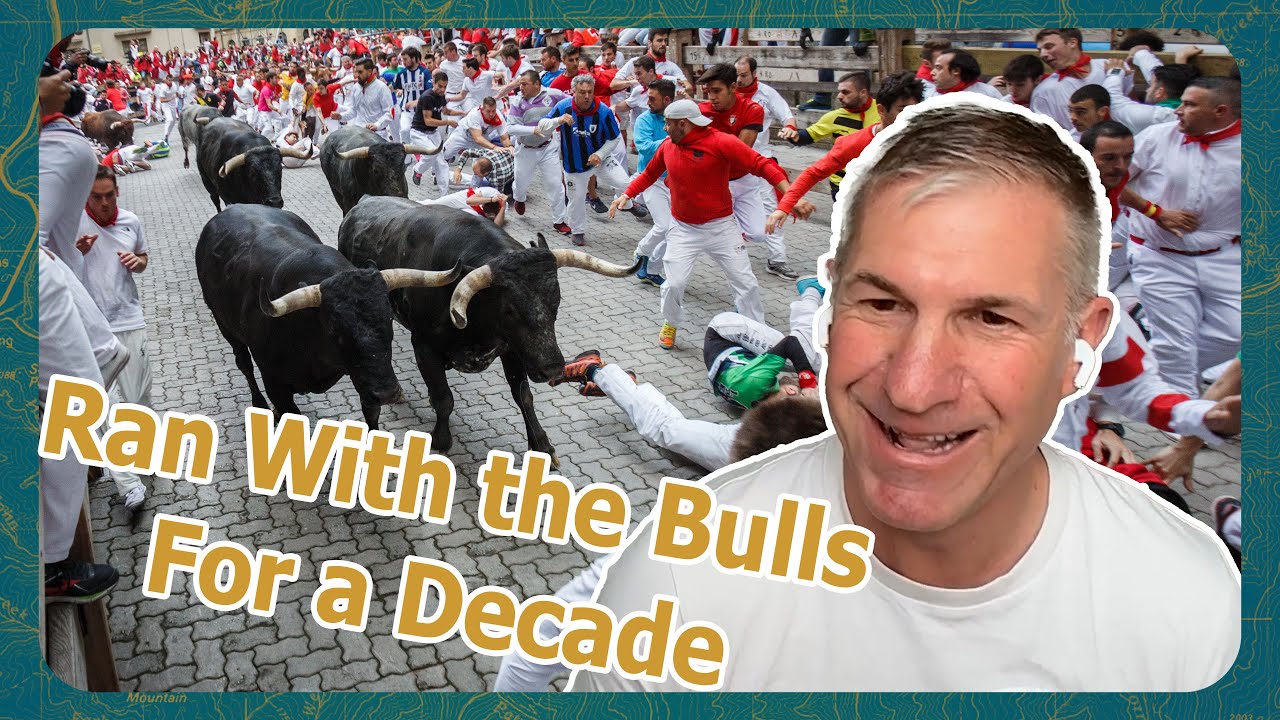
Zackery Ellis: Welcome to the Near and Far podcast. I’m your host, Zackery Ellis, and this show is all about embracing curiosity, leaping beyond your comfort zone, and learning from adventurers like yourself who have traveled near and far. We’re joined today by our guest, Javier Ochoa-Reparaz. Javier ran with the bulls in Pamplona, not just once, but then he kept going. He’s run with the bulls for about a decade. So welcome to the show, Javier.
Javier Ochoa-Reparaz: Thank you, Zack. Thank you so much for having me.
Zackery Ellis: Of course. Thinking back to that very first time you ran with the bulls, what were you feeling in the moments before the bulls started running?
Javier Ochoa-Reparaz: All right, so there are two different ways to do this or to do that. You can do it after you wake up and have a coffee or wherever your preferred morning drink is, and then you walk there and then you do it, or… You can continue partying and doing it, which is what I did the first time and the first few times.
Zackery Ellis: So you were partying the night before and the party just kept going and then you ended up running with the bulls?
Javier Ochoa-Reparaz: Which is what happens with most people who do that. So to give you a little bit of context, the festival starts on July 6th and ends on July 14th. And the first run is on July 7th so we have runs on the 7th, 8th, 9th, 12th, and the 14th which is the last one and they are always in the morning at 8:00 a.m. Now the festival, the party, is pretty big and there’s people coming from all over the world to participate and to have some fun, so the bars tend to stay open a lot longer than what they would be during the normal regular year. They might be open until 6-6:30 a.m., and then you basically continue because at that point it’s easy to continue I guess if you’re still up. So most runners, I don’t know if it’s most, many runners end up in the run in the trail or in the streets where the run happens and will end up after a whole night of partying and that’s exactly what I did for my runs when I was young.
Zackery Ellis: So the night before, did you leave the house and start bar hopping in the traditional Mozos uniform?
Javier Ochoa-Reparaz: Yeah, that’s the uniform. We put it on on July 6th. I mean, you have different clothes. Of course, it’s not always the same, but you have several repetitions of the same uniform. So you use them for an entire week or nine days. So you’re always dressing white, which actually is not a very old tradition. It happened several decades ago, but for some reason it became popular. And so now if you go to Pamplona during those days, most Pamplona people will dress white and red. So that’s what we do. And so, yeah, I mean, you just go out with your friends or whoever during the day. Most of the time that continues through the night because it’s really fun. And that continues through the morning after you have churros maybe and hot chocolate. And then around 6:30 or so, I might run today. So then you start walking to the streets where the runs happen. And then you have to wait for a little bit because the police tend to block the streets. And so you have to get there in time in order to run that day. And then you wait there for about a half hour or so, maybe longer, depending where you are in the run. And then they’ll shoot a couple of, you know, firework-type rockets, you know, to make the sound, to make you aware that at 8 a.m. the bulls will be released. So the first or the last 20, 30 minutes of that delay or that wait, well, you can be either not really knowing where you are, if you’re having way too much fun, or you start to get really, really worried because there’s a bunch of bulls that are going to start running where you are. And they’re all going in the same direction. So those 20, 30 minutes are a little, you know, you get… you tend to get nervous basically and you will see people stretching because it’s a run and you sprint. You know you have to be more honest mentally and physically ready to do it, and then the bulls are released and you’re on your own basically against bulls and a bunch of people.
Zackery Ellis: yeah i always assumed this was more something that people trained for do you run faster than the bulls which is true it sounds It sounds like your experience, it was a lot more spontaneous than that.
Javier Ochoa-Reparaz: Completely. But, I mean, I have friends or people that I know well in Pamplona. My dad has had friends that have done it for a long time. We all know people in Pamplona, and not only from Pamplona, from elsewhere within the region and Spain, that train for this. You know, that they really are, I mean, they’re not professional because no one is paying them, but they act as professionals. They train for these fans, and those don’t party. They’ll just go home. They’ll sleep. They’ll wake up. They’ll grab their coffee. And that’s a good way to do it. Okay? That’s the way that you should do it because you’re basically facing a massive bull. So you should be prepared and you should be rested and you should, you know, train for it. And many, many runners do that. But the reality is that many others don’t. And it’s very, very common to… to basically see people parking, and then in an hour or so, see them in the run, which happens a lot.
Zackery Ellis: What’s the closest you’ve ever been to one of the bulls?
Javier Ochoa-Reparaz: Oh, very close. I mean, you were right when you were saying that I started running, and I’ve done it for several years. I think I was 17 or so when I did my first one after those nights of partying. And I think the last time I ran I was probably 29 or 28. So during those years, I don’t do it, I wouldn’t do it every day, but every now and then two or three times, so several times per all of those years. At the end, you’ll have a close encounter because the reality is that there are only a few places where you can actually get off the trail or run unless you finish way too early, meaning that you make it to the arena before even the balls are released, which happens with… most of those that don’t know what is going on. And it probably happened to me those first three times because it’s pretty stressful. So you start sprinting as soon as you hear the noise. And by the time the bulls are in the middle of the run, you’ve already finished. Which again happens to many, many, many runners. So I don’t know the proportion. I’d say a big chunk of runners never run the bulls because they make it to the arena way before the bulls.
Zackery Ellis: Make it sound like you miss out on some of the fun if you get there too safely.
Javier Ochoa-Reparaz: I mean, it all depends on what you consider fun. Because you just might want to be there with your friends and get this adrenaline rush and that’s it. And you get it because you are in the middle of a street with a bunch of big bulls. So you still get that if you run, if you know exactly what is going on around you after a whole night of parking, of course. But then sometimes you just wait and then you start learning how to wait or where to wait and how to start or when to start running. And I did that a little bit later. At the end, if you stay within the course, the bulls will be at one point very, very close to you, because it’s a very, very narrow street. And again, as I was saying, there is really no way out. You just basically go to a corner or try to lay down on the ground or you fall because there are so many people that will push you. And you’re not supposed to touch the bull in the runs. It’s not. It’s not okay to touch the bull. You have to let them go. But again, there’s touching because there’s so many people and big bulls with huge horns. The one that I always remember is one that happened one of the last times I did it because I was pushed towards a wall and I hit the wall and then there was a bunch of people on top of me and there was a bull there too in there within the crowd i guess just ran over us and i didn’t get stepped or anything that’s one of the most common uh injuries is when a bull steps on you they have to go somewhere and they have to jump and they’re very very heavy so that can be very painful but i never had that issue but i think that was one of the closest situations.
Zackery Ellis: How dangerous is it? I always assumed it was not a safe event, but that was before I realized alcohol was involved.
Javier Ochoa-Reparaz: I mean, alcohol… Okay, so there’s a little bit of a legal empty space there, because you’re not supposed to be under the influence when you’re running. And the police will take you out if they see that you are too, you know, too drunk or…
Zackery Ellis: So you partied responsibly before running.
Javier Ochoa-Reparaz: But yeah, but it is very difficult for the police to control everybody. So they mostly focus on those that are carrying cameras or something that is big. That’s not legal and they cannot take you out of the run. You can harm someone with a camera. So you cannot do that, although every now and then you’ll see it. So how dangerous is this? I can’t remember how many people have died over the last 120 years or so, since I think there’s been more or less a decent time, basically, way to count. I’m going to say 15, 16 or so. So it’s not that the number of deaths is not that high compared, if you take into account all of the runs that happen every year and every year. But the injury, the number of injuries is high so every year there will be people that are horned not every day perhaps but yeah so so there might be four or five people that get severely horned per year and then many other minor minor injuries like fractures or maybe you hit the face the ground and then you start bleeding or whatever it is that’s very very common but Pamplona has, and i know that that also happens in other parts of Spain. There are other places we run. But the Pamplona in particular, basically the hospitals I have created in order to avoid delays, is extremely good. So you get horned, you start getting treated right down the street, and within minutes you’re in a hospital. It’s very, very efficient. And I’m sure that that has saved many, many lives throughout the last years.
Zackery Ellis: And obviously getting horned is about the most salient thing that people think about when it comes to injuries here but you said you ended up falling and people were running over you…
Javier Ochoa-Reparaz: Yeah, so I’ve never had big issues other than scratches. But again, I’m not, even though I run it multiple times, that’s nothing compared to people running every day for every year. And we all know, we all in Pamplona know somebody who does that. The more often you do it, you know, the higher the chances are, right? Even if you’re very, very good, lots of things that you cannot control. Mostly because of the people or how slippery things are or whatever. So at one point, yeah, you’ll have an issue.
Zackery Ellis: What’s more dangerous, the bulls, the people, or the street itself?
Javier Ochoa-Reparaz: Well, the street itself, it used to be pretty, well, I’m not going to say pretty slippery. It used to be a little slippery when it would rain or when they would clean the streets. But now they use a solution that makes it anti-slippery. So the street itself is not that difficult anymore, other than the fact that, again, it’s a very, very narrow street with walls and it’s hard to get off. People, for sure, depending on the day, the weekends are massive, really, in terms of crowds. Saturdays, Sundays are extremely busy. So you can encounter issues those days, depending on… and the type of bulls that run. The organizers also control that. There are some ranches or farms of bulls that are known for they’re easier to run with people. They don’t really go against people. They just go with them, while others are a little bit more, let’s say, nervous, and they go left and right. So they control the type of bull that runs over the really busy weekend days. Back to your question. I mean, obviously a bull is per se, it’s more dangerous than a human being, right? Because it’s, I don’t know how many times heavier, and their horns… But again, most of the time you’re going to be around the people. And for a second, if you are a very good runner, which I was not, you’ll be running in front of the bull. So then at that point. But at the same time, you’re going to have to start jumping people and maybe fighting with elbows, overs. So it’s a combination of both. I don’t know which one I would say it’s more dangerous in terms of the number of injuries. I would probably say that the crowds may cause more injuries than the bulls, but the injuries caused by the bulls are heavier and bigger and more dangerous, if that makes sense.
Zackery Ellis: So you’re going to get that adrenaline rush wherever you are.
Javier Ochoa-Reparaz: Wherever you are and even if you watch it. Tthere are balconies all over the run and you’ll see you’ll hear screams when people are screaming when they see the bulls and you can actually feel the sound. It’s just very, uh, it’s very primitive. It really is. It’s kind of a stupid thing. It’s stupid. It’s a stupid tradition. But it’s so inherited within the nature of the city that it’s, you know, people feel it very, very deep inside. So regardless, you’re running or outside watching it, the adrenaline levels go up.
Zackery Ellis: How did the tradition get started? Because I know San Fermin was not known for buwls, right?
Javier Ochoa-Reparaz: No. So San Fermin is a saint, of course. And it’s one of the cities, I don’t know how that’s said in English. You know, it’s one of the two sides of the city, basically. The tradition started after or around a fair, like a cattle fair. And the tradition that cattle fair was around that religious day, basically. Which, by the way, used to happen in a different time of the year. But the weather was so bad that they moved it to July. I think it used to be in the fall when it was rainy and the weather can be pretty bad in Pamplona. So they moved it to July. But anyways, it all started around that fair with cattle. You know, bulls in the Spanish peninsula in Spain are very, very common everywhere. So there used to be bullfights. And the bullfight in Pamplona was in the center of the city. So they would have to move the bulls from outside the city to downtown, which is very narrow and small and, you know, packed. And that’s where the bullfight would be. So the tradition started like, well, let’s move the bulls to the arena. And then somebody decided to start running them. And I think that’s how it started, but I’m not… I’m not an expert, but that’s the story that I’ve always heard in Pamplona.
Zackery Ellis: Yeah. In just a moment, let’s come back and talk more about Pamplona, which is one of the larger cities in the Basque region of Spain. And Basque culture is just so interesting. So many delicious foods originated out there. And we’ll be right back.
[Brief intermission]
Zackery Ellis: Pamplona is part of the Basque region of Spain, but it isn’t part of what’s called Basque country. So for those who don’t know, what exactly is Basque culture?
Javier Ochoa-Reparaz: Okay. It’s an important and tricky question to answer. It requires some background. The first thing I’ll say, though, Pamplona is the capital of the region of Navarre. Navarre is a region within Spain that was its own kingdom for centuries, which was completely independent from any other kingdom within Spain or France. It maintained, what would you say, privileges that some of them are actually retained over up until now. So is it semi-autonomous? It’s not semi-autonomous, but we collect our own taxes, for example, just to give you an idea. But Navarre, the region, was militarily conquered by Castilla and Aragon, which was part of Spain at that time in 1512. So for about 300 years, it was a country within a country, basically. So that’s Pamplona and that’s Navarre, which is not officially part of the Basque country itself. The Basque country, or it’s also called the Euskadi, is a region in Spain with three provinces, Vizcaya, Gipuzkoa and Álava. Vizcaya is where Bilbao is, Gipuzkoa is where San Sebastian is and then Álava, the capital of Álava, is Vitoria or Gasteiz. And that’s the official Basque country within Spain. So the Basque culture is different and the Basque culture is defined by the language which is Basque or Euskera. So those that are considered Euskaldun means that those are the ones that speak the language Basque. So that culture, and it’s not only the language of course, there are some cultural uniqueness in terms of the traditions that the Basque community has that are slightly different or in some cases very different to the communities that are around the Basque region. So Pamplona is within that area in Navarre with big Basque influence, although it’s a big city. It’s bigger than other little towns around the region. It’s kind of like the size of Boise, actually.
Zackery Ellis: Boise, Idaho?
Javier Ochoa-Reparaz: Boise, Idaho. So about 200,000 or so with other cities around. And within that population, there’s a small fraction of those that speak Basque, Basque-speaking language is uh it’s relatively low to compare to northern parts of the region so for example where my parents are from it’s a little valley in the northern part part of Navarre I would say 95 percent of people speak Basque okay and it’s not officially part of the Basque country it’s part of Navarre but then many others don’t speak Basque in my region so the southern part of Navarre, they speak Spanish and many of them, most of them probably don’t consider themselves Basque because they don’t really have a Basque culture. OK, so it’s a little confusing. But again, if you are in the north part of Navarre, the Basque influence is huge. And I would say over 90 percent of people will, or 85 or whatever it is, will actually consider themselves Basque. So I consider myself Basque from Navarre. That’s what I consider myself, yeah, because I speak Basque.
Zackery Ellis: Is Basque one of the official languages of Spain?
Javier Ochoa-Reparaz: Yeah, so Spain has, well, obviously Spanish, and they have Galician, or we have Galician, Catalan, Basque, and those are co-official languages. And they’re distinct languages, not just dialects of one another. Those are considered languages, and there are a few other dialects. And the most different one, the really different one is Basque, because it’s not a Latin-type language. Galician is its own language, and Catalan is its own language. But if you’re from Spain, you can get some, you know, you can get some words and you can get to understand the context of the conversation. But if you go to one of those small villages in the Basque country or the Basque region of Navarre, you’ll understand nothing, really.
Zackery Ellis: You mentioned Boise, Idaho real quick, which for those who don’t know, I believe it has the largest Basque population outside of Spain. Is that correct?
Javier Ochoa-Reparaz: Yeah, that’s correct.
Zackery Ellis: In downtown Boise, there’s a Basque district with some absolutely amazing restaurants, if you’re ever in the area. Definitely swing by and try some Basque food. What makes Basque cuisine different from cuisine elsewhere in that part of Spain?
Javier Ochoa-Reparaz: Well, I’m going to say that I’m only good at cooking sangria, so I’m not the best person to talk about cooking. But what I think it is, although I do come from a family that owns a Basque restaurant in the Basque region of Navarre, so I’ve been exposed to really, really good food my entire life, but I have never learned how to do it myself. I honestly think that the main difference is the quality of the produce. There are some recipes that are part of the region, but I think what defines the traditional Basque cuisine is the quality of what they use. And it tends to be simpler than other cuisines, but it’s just good quality. Steak is a big thing. Lamb is a big thing in the Basque region, Basque country. Fish is extremely important in the Basque culture and the Basque country because it’s basically right there. The Basque country has a big portion of it on the coast. So fish is big, seafood as well, vegetables. And I don’t know, again, I’m not a kitchen person that much, but I really think that what defines the Basque cuisine is the quality of what is served.
Zackery Ellis: And did Basque people invent chorizo? Am I remembering that right?
Javier Ochoa-Reparaz: So chorizo is very, very common in Spain. So there are many other regions in Spain that have really, really good chorizos. In the south, chorizos are incredibly good. I don’t know if you are familiar with jamón and jabugo in the south of Spain. It’s, you know, it’s ham. It’s kind of like prosciutto, Italian prosciutto, but really, really good. So they also make their own chorizos. So it’s not a Basque only thing at all. Now, in the Basque Country, chorizo is big, and we have different versions of it. And my mom, for example, is from a little town called Arbizu, which is known for its own type of chorizo, which is called chistorra. Chistorra is very, very common, particularly in Navarre, but that little town is called for its own chistorra. And chistorra is just a thinner type of chorizo with a bunch of paprika, and it’s really, really good. It’s one of my favorite things to eat.
Zackery Ellis: I’m going to have to make it over there and try some.
Javier Ochoa-Reparaz: No, you can actually eat it here. Well, if you are in Boise, those that are able to travel to Boise, you can find a couple of places where chistorras are made really, really well. I can give you some hints.
Zackery Ellis: What do you do for fun in Pamplona when the bulls aren’t running? I take it you’re a fan of the Osasuna football team?
Javier Ochoa-Reparaz: Yeah, Osasuna. Yes, of course. Football is one of my… I used to play football for… I played football for most of my youth in school and also with my friends outside school. So that was one of my hobbies when I was growing up. Pamplona is a pretty safe place. So it was always fun to just get on the bike and mess around as any other kid will do. Going out with my friends when we got a little older, that was my number one hobby. We would have a lot of fun. But yeah, also… Just going around being a kid.
Javier Ochoa-Reparaz: And then, yes, football. Watching football, going to the stadium, to Osasuna Stadium was a big part of my childhood. I would go with my dad and my uncle first. And then I started going with one of my cousins. And I did that for many, many years. And then with a good friend as well. We would go every weekend or basically every game it would happen in Pamplona. The stadium is at a walking distance from anywhere in Pamplona, so it was really easy and it was affordable at times. Then it got a little more expensive. But anyways, it’s fun. I really like it. I’m a huge Osasuna fan. I’m not an ultra or one of those hooligans. I’m not like that, but I really follow the team.
Zackery Ellis: Does Navarre have a ton of football hooliganism?
Javier Ochoa-Reparaz: Well, Pamplona, and Osasuna is the only professional team in Navarre. So those that are hooligans are going to be part of the Osasuna crowd. And there is a group that has been notorious for their hooliganism in Pamplona’s Osasuna’s crowd. It’s called Indar Corri. And they’ve been functioning for, I mean, I was a teenager or so when they started. So they’ve been going on for the last 30 years or so. I don’t like them that much, but anyways I’m not gonna go there because sometimes they, you know, they are hooligans so you know they do things that you shouldn’t do.
Zackery Ellis: Even though some some American teams definitely have reputations for more unruly fan bases, I think the culture of hooliganism is something that we’ve luckily avoided over here.
Javier Ochoa-Reparaz: I agree with you. I think one of the differences is that hooliganism in Europe is basically organized. And it’s not only organized, it’s also influenced by politics in many different ways.
Zackery Ellis: Really?
Javier Ochoa-Reparaz: Yeah. Oh, yeah. So if you look at the list of hooligans within Spanish teams or the Basque country teams, you can clearly define the politics of each of them.
Zackery Ellis: So are there like communist hooligans, fascist hooligans?
Javier Ochoa-Reparaz: You could definitely separate things like that. You can have hooligans that promote the independence of the Basque country, for example. And perhaps a big chunk of those in Dargory or Osasuna fans want that. But then you also have hooligans in Madrid that are more towards the far right. At least they were. I don’t know the situation right now, but when I was growing up, there was a big group.
Zackery Ellis: I remember you telling me about going to football games in other cities when your team would be on the road. The reputation around Basque separatism would impact how people treated fans.
Javier Ochoa-Reparaz: Yeah, absolutely. Yeah, yes. So that happened in the 90s. getting into my 20s in the middle of the 90s. But anyways, that’s when I would go out or go and travel a few times or travel every now and then with my team and most of the time with my uncle, with my cousin and a couple of friends. And the 90s was a pretty harsh time in Spain, considering or when taking into consideration the Basque separatism and the Basque terrorist group that used to be effectively basically functioning and killing people in Spain. So because of that association that everybody makes between the hooliganism in soccer and football and politics, Osasuna’s hooligans would be completely 100% associated with the Basque separatism and terrorism. So even though you would not travel with them, they would normally travel on their own with their own bus, but you would be with the crowd of Osasuna. So, you know, every now and then you would get comments and somebody would insult you and things like that based on where you’re from and the fact that you’re supporting Osasuna, which I guess, I mean, it’s what it is. It happens the same thing in Pamplona when other teams get to the city. They will probably, somebody who has nothing to do with their hooligans will be affected by it. Sometimes we had to run in the streets because those that are part of the hooligan team would start throwing stones at the police, and I was there, so then we would have to stay away from it. But I was not a part of that hooliganism, but I was directly affected every now and then.
Zackery Ellis: So when you were growing up, the separatist terrorists were conducting bombings and other other acts of violence. What was it like being around that during your formative years
Javier Ochoa-Reparaz: So you are a kid you are you’re i mean let’s say you’re 12, 13, 14, 16 you start going out with your friends at 17 or so and and then you realize once it’s not happening, you realize that you get used to that which is terrible. It shouldn’t be there, but you live within an environment that makes you get used to that violence. And there would be violence in every different aspect. There would be violence when you were watching the news and every week or so, there would be a bombing in Madrid or in Barcelona, and they would kill a bunch of people. Or there would be somebody that was shot in Bilbao or San Sebastian or Pamplona. And you would listen to that and say, oh, another one. So there was so much violence that I guess you got trapped.
Zackery Ellis: So it’s interesting to think about that when there’s no violence and how horrible that is. So you were desensitized to it and it was just normalized?
Javier Ochoa-Reparaz: There’s so much of it. And there’s also a lot of fear within the environment because you don’t want to speak up. I mean, if you are part of a small community and you are against that terrorism, but you know that you are surrounded by a bunch of people that support it. There’s a lot of fear about that. So there’s a combination of desensitization and also active avoidance because of fear. And that still happens in some small places. I mean, honestly, I think that the problem is still there. The fear is still there. So there will be many generations to pass before that is over um yeah so we would go out with our friends and and my friend and i we never i mean the only one the only thing we wanted to do is have some fun really we were never involved on any any anything like that But sometimes it would just have to run because the police was in one side and the terrorist separatist supporters were on the other side. And they were throwing stones and the other was shooting rubber bullets. So it was a very violent situation that we had to live with for many, many years as we were growing up. And then… I mean, there are events that I still keep in my mind because I remember when we were 13 or so, somebody from my school was killed, a kid. And I think he was a couple of years older than I was, or maybe three years older. But he was killed because the terrorists put a bomb in his front door because there’s somebody else living within that building and they wanted to kill that person, but they ended up killing the kid. I don’t remember if that other person was killed as well, but the kid died in that terrorist act. So you live in that environment. How is it that you were able to do that? This incitation, and in some cases a fear, I think for many was a big, big chunk of it.
Javier Ochoa-Reparaz: ‘ll give you another example. I remember one of my friends had an American high school kid visiting, you know, an exchange program to spend a couple of months in Pamplona to learn Spanish. And we took him out one summer night and we were having some fun and we were just in one bar and another one. Drinking age was still 18. I think it was when we were growing up, you know, you can still go out and have a couple of beers. And that’s what we were doing. And I remember getting out of a bar with my friends and this kid. I don’t remember his name. And there was a bus on fire right in front of us. A real bus on fire because of the violence. And this kid was like, what is going on here? I mean, he was really scared. And we were just, oh, yeah, you know, another one, you know. So that’s the difference. Somebody who’s not exposed to it is terrified. And us, it’s not that we’re braver. We’re not. We’re just used to it. We’re just used to it. And it’s very sad.
Zackery Ellis: Just glad you weren’t on that bus.
Javier Ochoa-Reparaz: Well, they removed the people, so they want to set the fire, the bus on fire, that way they can use it as a barricade or basically to, you know, to make it, to make themselves noticeable. Yeah, it was a hard time. And everybody knows people that support them, the terrorists, I mean. And I honestly think that that’s a problem that is going to last. Even though there’s no terrorism anymore, there’s enough support, which they support with violence. I’m not going to support whatever it is. I don’t care. So even though the ideology is still there, the will for a separatist movement and the fear is still definitely there from people who remember what that could devolve into.
Zackery Ellis: It’s been a long time since there’s been widespread violence regarding these political motivations, right? So what has changed since now it is a safe place for tourists to go?
Javier Ochoa-Reparaz: It’s a safe place for a tourist to go. I think fear is still present in those smaller communities, those that think differently, don’t want to speak up. For anyone else visiting, it’s extremely safe. It’s very safe. I think what happened maybe about 20 years ago or so, 16, 17, I don’t remember exactly when. The terrorist group was dismantled in 2010 or something. I don’t remember. I think what happened is that they even realized that they were not going anywhere with it and that they had to use politics in order to gain something because they did. I mean, there’s a city not far away from Pamplona. It’s called Zaragoza. They put a bomb in one of the grocery stores. And they killed 20-something people. No, that was in Barcelona, not in Zaragoza. So how can you get something like that that is so horrible? So I guess they slowly realized that they were not going anywhere with it. And also, the police were getting really, really good at catching them. So they also realized, “well, we are not going anywhere. And at the same time, we ended up in jail. So let’s get moving and let’s move into politics,” which is the current situation. That’s pretty much what happened with Sinn Féin in Ireland. You know, the political arm of the group gained power and it became just the only thing, and the same thing happened in the Basque country. Still, the problem is still there. I don’t think it’s gone.
Zackery Ellis: Now that they realize violence wasn’t working and now that it is a safer place for tourists to go, let’s come back in a moment and I want to hear about Pamplona of today. It sounds like you might have some good tips for navigating the city if you’re in search of good sangria, good food, and good fun.
[Brief intermission]
Zackery Ellis: I’ve read a lot about how Barcelona has been dealing with overcrowding they are putting in new regulations about Airbnb’s because tourists are flooding into the non-touristy parts of of town. I’ve read about them wanting to put limits on how many cruise ship passengers can come in, and in the lines at the Sagrada Familia you can wait hours just to go in and see the cathedral. Pamplona doesn’t necessarily have those same tourist overcrowding problems does it?
Javier Ochoa-Reparaz: No, not at all. I was in Barcelona three years ago, as a tourist, and it was really shocking the amount of people that go there. It’s not that I support the actions against those that are visiting places just for fun, but I understand the locals too. Pamplona has no issue like that. It gets very crowded during the festival, but the rest of the year it is a very very peaceful place. Pamplona is part of the El Camino, the pilgrim way, where people walk for about 600 kilometers or so in two months or whatever it is. Pamplona is one of the cities within one of the routes there, so we get that kind of tourism. We also get weekend tourism from France and other cities in the Basque Country or from the rest of Spain, but we don’t have that issue at all. It’s a very very shocking situation in big cities in Spain: Sevilla, Granada, Cordoba. They’re massified by tourism.
Zackery Ellis: If I were to visit, what could I do to be one of the good tourists? What can I do to be a respectful tourist?
Javier Ochoa-Reparaz: I think it is important to adapt and to blend, basically. Look around and see how people behave. Pretending you’re not a tourist, I think, is the best way to do tourism because then you might be getting to places that you were not expecting just by following those that are local. You might go two or three streets in, and you might find a very very small tapas place or Pinterest place that you didn’t know because it’s not in your book, um the tourist book. So I think you will also avoid some issues because, you know, pick pocketers, for instance, in Barcelona, Madrid and big cities, they are always looking for tourists. So if you don’t want to have an issue, don’t look like a tourist and pretend you are a local. And sometimes it’s really hard depending where you are. But, you know, I think it’s a good strategy. And I definitely try to do that when I travel.
Zackery Ellis: What can someone who looks like me do to look more like a local?
Javier Ochoa-Reparaz: They probably might notice, “oh well you know he’s not from around here but he might be living here.” You might study there or you might be working there, but that doesn’t make you a tourist. Don’t open the map like this in front of everybody. There are a few things that you can do, and also everybody should be very respectful with whatever we see around us, which is probably also a good way to learn about the way people live in those places.
Zackery Ellis: The idea to not act like a tourist, when you truly immerse yourself in wherever you are, there’s the expression, “when in Rome, do as the Romans do,” you learn so much about why people there act the way they do.
Javier Ochoa-Reparaz: I guess everything depends on the way that your trip is organized. So let’s say if you have a week and you are supposed to visit four different cities, that’s a very different situation. If I have a week, I’m just going to pick one of those cities. I’m going to get an apartment. And then I have a whole week to walk around. Maybe I’ll repeat the same coffee shop because I like it. and that’s kind of like basically what a local does. That’s the type of traveling that I like, so every now and then we’ll do these shorter trips where you visit different places, and it is harder to pretend that you’re not a tourist when you’re in that situation right? Because then you have, you know, these four iconic places that I want to visit within the city. I personally prefer to go to one and avoid the other two and basically walk around. I don’t have to see everything. I prefer to get a sense of the place and avoid going to the cathedral, but sometimes it’s really hard because the cathedral is spectacular and you know you want to see it. I’d rather use that time to walk around or even sit at a table outside having a beer and looking because I really like people watching. So that’s what i like about traveling
Zackery Ellis: The way i see it, every moment that I spend waiting in line for something is a moment that I’m not enjoying local food
Javier Ochoa-Reparaz: yeah yeah that too it’s just i guess it’s a different type of strategy when traveling but um Sometimes it’s hard to do it, depending on the time. But for example, I’ll give you an example. One of the most common ways for me to travel is when I go to a conference. And the conference is for work. It lasts two or three days, but I will stay two more days. And I don’t visit anything. Some people say, “”well, you didn’t go to this thing.” No. “So what do you do?” Nothing. I just stay. But I like it. I mean, so yeah, when I talk to others, “How did you end up not going to the Louvre, the museum, or to the pub?” Because I’m sure it’s really nice, but I have other priorities and I’d rather stay and walk around and sit and have a beer or two or a coffee than wait in line. I hate waiting in line.
Zackery Ellis: Sometimes I’ll schedule flights with long layovers so that I can spend, let’s say, 16 hours in a city. T how I ended up in Paris, and instead of spending all of my hours at the Louvre, my wife and I hung out in the Montmartre district and just drank wine, ate croissants, and it was a much better time than elbowing through people trying to see the Mona Lisa.
Javier Ochoa-Reparaz: Absolutely. Yeah, I’ve done that a lot, too, in London. In Reykjavik in Iceland too, I stayed overnight there. They have a program in Iceland, you can do that for the same price and a few other cities.
Zackery Ellis: I think the Iceland government actually encourages IcelandAir to make it easy for you to have long layovers. You can spend the day in Reykjavik. You used to be able to schedule layovers for three or four days so that you could also drive around Iceland’s Golden Circle, see a bunch of famous waterfalls, and the national park where you can see the continental rift. And I just love traveling like that.
Zackery Ellis: Speaking of travel tips, when in Spain, I think you’ve, am I remembering right? You’ve told me before that if you go into a restaurant, the bar is on the first floor and that’s where all of the tourists hang out and order appetizers and stuff. But where do you go for the really good food?
Javier Ochoa-Reparaz: Sometimes there’s a, depending on the restaurant, you’ll find a front bar where it’s really packed. And then, there’s often a second dining room where the tables and the restaurant are located. We were in Madrid last December and we were just wandering around where we eat. It was really busy because it was during Christmas time. And we found one of those where the restaurant was fine. But then looking at the bar itself where everybody was having tapas, it was just impossible. So you look around because there’s always, not always, there’s a possibility that there’s going to be a quieter place inside that not everybody knows. The locals will. but not the tourists.
Zackery Ellis: How would I ask for that place? How would I go about asking to get to that part of the restaurant?
Javier Ochoa-Reparaz: Well, you can ask or you can start walking around. If somebody tells you, “where are you going?” You can do it. I mean, it’s fine. It’s a public space, not public, but you can get in, I guess. So if they tell you, “hey, you’re not you’re not supposed to be here,” you’ll probably understand even if it is in a different language. You can ask if there’s another section for the restaurant.
Zackery Ellis: Circling back, going all the way back to running with the bulls, you haven’t just run with bulls right? What other animals have you run with, Javier?
Javier Ochoa-Reparaz: So, when I moved to the U.S. in 2005, my first place was Bozeman in Montana. I think it was my first summer there. I met some friends, and we started exploring Montana. And on one of those trips, we randomly found a little town called Wheat Point, which is not far from Bozeman, and they are known for the running of the sheep.
Zackery Ellis: The sheep?
Javier Ochoa-Reparaz: The sheep, yeah. We’d go to Montana, there would be sheep, and then there would be people dressed up like somebody from Pamplona, white and red, in front of the sheep. So they were pleased to learn that I was actually from Pamplona, and some people took pictures with me. So I was the only tourist there. But they found that really fun.
Zackery Ellis: Did any of the sheep have horns?
Javier Ochoa-Reparaz: No. But there were many of them.
Zackery Ellis: What about fake horns?
Javier Ochoa-Reparaz: No fake horns. But there were many of them. So if you fall, you might be in trouble. It was really safe. But it was a fun party.
Zackery Ellis: Is the night before running with the sheep also filled with sangria?
Javier Ochoa-Reparaz: I don’t know that part because we were there for the day, but the bars were packed during the day. So maybe not sangria, but all the beverages for sure were running around. Yes, we had a good time. And then not so long ago, less than two months ago, I was at a conference in Anchorage and my flight got cancelled. And I started asking around what to do. And basically it was the beginning of the dog sled competition. I don’t remember the name of it.
Zackery Ellis: Iditarod? Is that the one?
Javier Ochoa-Reparaz: Iditarod, yeah, Iditarod. So it would start in Anchorage that day. I was watching it and I met these people who were watching it with me and I said, “geez, I was looking at my phone and my flight got canceled. I have to stay overnight here.” And so, “well, you can run the reindeer.”
Zackery Ellis: Run the reindeer?
Javier Ochoa-Reparaz: So, yeah. So I ended up running with the reindeer that day after a couple of beers. Yeah.
Zackery Ellis: Do they just release a bunch of reindeer?
Javier Ochoa-Reparaz: And yeah, they do. Well, not a bunch. I don’t remember the street, but it’s the main street in downtown Anchorage. And then a bunch of people running, many of them wearing costumes, dressed up. Not Pamplona costumes, but fun costumes, right? There’s one person dressed up as a Pamplona runner. And I actually talked to him, and I wish I had taken a picture with him. He was there. He told me that he was in Pamplona last summer. So, yeah, so he was dressed up. So they basically separate the runners into four or five groups to make it a little more manageable. And then the reindeer, they basically circle around and they run again. And they are coming from a farm and some of them are missing one (antler). It’s really, it was fun. It was a good time. I had a good time, but it was completely unexpected because I was supposed to be flying at that time, and I ended up running the reindeer.
Zackery Ellis: Well, both running with the sheep, running with the reindeer, those seem like good entry-level events for people who are considering running with the bull someday.
Javier Ochoa-Reparaz: It is. It’s pretty much the same thing. It’s a human and another animal behind. Just the animal is different. But yes.
Zackery Ellis: This has all been fantastic. You’ve been living a really fun life, Javier, and thanks for sharing your travel wisdom with us today.
Javier Ochoa-Reparaz: Thank you, Zack. I don’t know if we talk too much about travel, but it’s fine.
Zackery Ellis: Well, travel, Pamplona, this has been a lot of fun.
Zackery Ellis: Thank you for listening to the Near and Far podcast. If you liked this conversation, don’t forget to subscribe, leave a review, and share it with your fellow explorers. You can find more episodes like this on Spotify, Apple Podcasts, YouTube, and www.nearenfar.travel, or wherever you enjoy your favorite podcasts. I’m your host, Zackery Ellis. Stay curious, stay adventuring, and stay exploring near and far.